Shotokan Karate is a traditional Japanese martial art with a lineage that can be traced back hundreds of years. Shotokan techniques include blocks, strikes, evasions, throws, and joint manipulations. When it comes to techniques, we believe that less is more. By this, we mean that we prefer a small set of highly refined techniques compared to a large set of techniques of which we only have a basic understanding. Because of this, our practices can appear to be very repetitive. However, it is this repetitive practice that allows us to continuously refine these techniques over many years.
Self-defense and development of one’s character are the primary goals of our practice. Competition and tournaments are only a small part of our training, not the focus. The goal is steady, lifelong improvement, not knockouts or trophies.
Learning how to defend yourself against a real attack, or how to overcome mental and physical adversity is not something that is easily done. It requires dedicated training. Only then can you learn how to face an opponent, or yourself, with confidence and a strong mentality. Because of this, our practices can be physically and mentally challenging, though that challenge is relative to the physical condition of the student.
Our Lineage
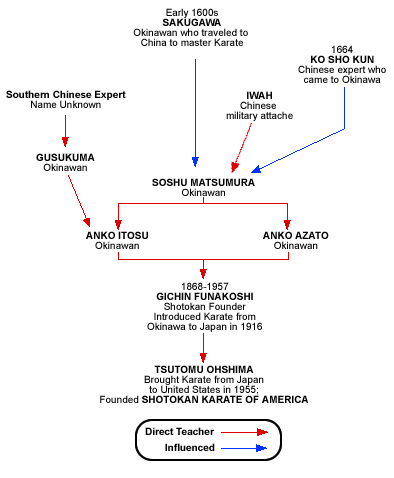
Shotokan Karate of America was founded by Tsutomu Ohshima. Tsutomu Ohshima was one of Master Funakoshi’s last direct pupils (1948-1953), studying under him while attending Waseda University in Tokyo, Japan. In 1955 Mr. Ohshima came to the United States and was the first person to teach karate to the US public; in 1957 he made the first public demonstration of traditional Shotokan karate in the United States, at the annual Nisei Week festival in Los Angeles. The following year (1958) Mr. Ohshima presided over a full karate tournament at Nisei Week, a practice he continued for decades; SKA’s Nisei Week event is the oldest annual karate tournament in the US.
In 1959 the Southern California Karate Association (SCKA) was formed, which grew to become a nationwide organization, Shotokan Karate of America (SKA). Ohshima Sensei was recognized as shihan (chief instructor) of many other national organizations; thus his influence on karate is felt globally.
Today thousands of Ohshima Sensei’s black belts are training and teaching throughout the world, maintaining their commitment to authentic, traditional karate-do and doing their best to provide an answer to the question posed by Master Funakoshi: “The Way: Who will pass it on straight and well?”
Shotokan Karate of America continues to be led by Mr. Ohshima’s students, who are committed to carrying on the legacy and teachings of Mr. Ohshima, Master Funakoshi, and the seniors before them.
Practice Format
Karate practice is divided into three aspects. Each of these aspects is of equal importance.
- Kihon – the practice of basic blocks, punches, kicks, and stances
- Kata – prearranged forms and movements that teach us techniques that will work against various attacks in different situations, and how to apply them swiftly and strongly
- Kumite – sparring with opponents
Our practices follow an ongoing training format. We do not have the concept of a session, semester, or season in our training. Members meet all year round to practice. As Master Funakoshi, the founder of the Shotokan style, once said, “Karate is like boiling water; without heat, it returns to its tepid state.” For this reason, the serious karate student practices continuously, day after day, year after year.
While the atmosphere in the dojo is serious, friendships quickly develop. Members encourage each other, push each other, and take care of each other. When sparring, members will face each other strictly and honestly, because they want their partners to learn how to face real attacks like they would face on the street. When sparring, senior students push the junior students just above their current level, helping them learn without causing injury. We realize that the worst thing we could do to our partners is facilitate in their development of a false sense of confidence. It is because we care for each other that we face each other strictly, seriously, and honestly.